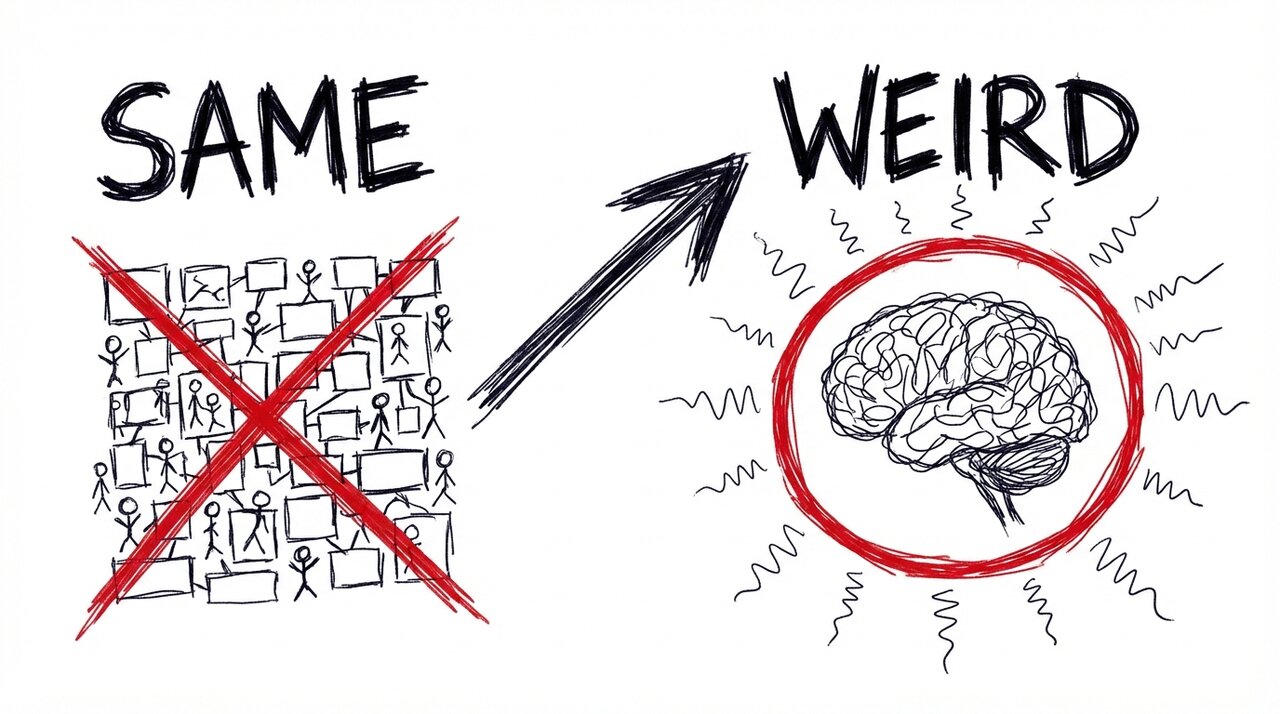
Everyone’s reading the same books.
Watching the same YouTube videos. Taking the same courses. Following the same thought leaders. Reading the same Twitter threads about productivity and frameworks and “how I built X.”
And then wondering why they feel interchangeable.
Weird Knowledge Compounds
When you know something most people don’t, it compounds in strange ways.
You see connections others miss. Someone mentions a problem and you think, “Oh, that’s actually similar to this obscure thing I spent months on.” You become the person people ask about the weird thing. Opportunities find you because there’s no one else to ask.
Generalist knowledge competes with everyone. A thousand people can explain the basics of machine learning. A million people know JavaScript.
But the person who deeply understands, say, the history of failed programming languages? Or the weird edge cases of distributed consensus? Or how typography affects reading comprehension in technical documentation?
That person has something.
Find a Lane
What’s something that genuinely interests you that most people ignore? Go there. Go deep.
Not deep like “I read a few articles.” Deep like you could write the articles. Deep like you notice things other people miss because you’ve spent enough time there to see the patterns.
This Isn’t Pigeon-holing
The fear is always: if I go deep on one thing, I’ll be stuck there forever. I’ll be “the X person” and nothing else.
But that’s not how it works.
Deep expertise in one area gives you a foundation. A perspective. A lens that nobody else has. You can expand from there. The depth in one place makes you more interesting everywhere else.
The people I find most compelling aren’t generalists who know a little about everything. They’re people who went absurdly deep on something specific, and that depth colors how they see everything else.
How to Find Your Weird Niche
Follow curiosity, not trends. What do you find yourself reading about when you’re not trying to be productive? What rabbit holes do you fall down at 2am? (I wrote more about following ideas where they lead.)
Look for intersections. Your weird niche might not be a single topic, but the overlap between two things that don’t usually touch.
Pay attention to what others dismiss. “That’s a solved problem.” “Nobody cares about that.” “That’s too niche.” These are signposts. The dismissed territory is often where the interesting stuff lives.
And honestly? Just pick something. The cost of going deep on the “wrong” thing is lower than you think. You’ll learn how to learn. You’ll develop taste. You’ll see patterns. That transfers. And compounds.
The Real Risk
The real risk isn’t becoming too specialized.
The real risk is staying in the middle of the pack, knowing what everyone knows, thinking what everyone thinks, wondering why nothing feels distinctive.
True original thinking is rare. Not because it’s hard, but because most people won’t go where it lives. They stay where it’s crowded. Where it’s safe.
The weird stuff is where the value is.