I’ve been online for a long time. Like, a long time.
I had a MySpace page with a carefully curated Top 8 and custom CSS and a sweet autoplaying music player, probably Nickleback. I maintained Tumblr blogs with specific aesthetics (one for photography, one for quotes, one for whatever vibe I was chasing that month). I’ve written on Blogspot, WordPress, Xanga, TypePad, Medium. I’ve been on Facebook since you needed a .edu email address to sign up. Twitter since 2008.
I’ve been around.
And honestly, it can be exhausting.
The Weight of Curation
Every platform, past and present, has its own game. Its own algorithm to understand, its own culture to navigate, its own unwritten rules about what “works.” What gets engagement. What builds an audience. What makes you look professional or interesting or hireable or whatever the goal is supposed to be.
Somewhere along the way, “being online” became synonymous with “building a personal brand.” You weren’t just sharing thoughts. You were crafting an image. Curating a feed. Being consistent. Staying on-brand.
I’ve tried many times. I’d start a blog with grand intentions, post consistently for a few weeks, then feel the pressure mount. Is this on-topic enough? Does this fit my niche? Will this help or hurt how people perceive me professionally? Should I be more controversial? Less controversial? More polished? More raw?
The questions pile up until writing feels less like expression and more like performance.
Two Different Things
Here’s what I’ve realized, and it took me embarrassingly long to see it clearly: finding your voice and defining your personal brand are two completely different things.
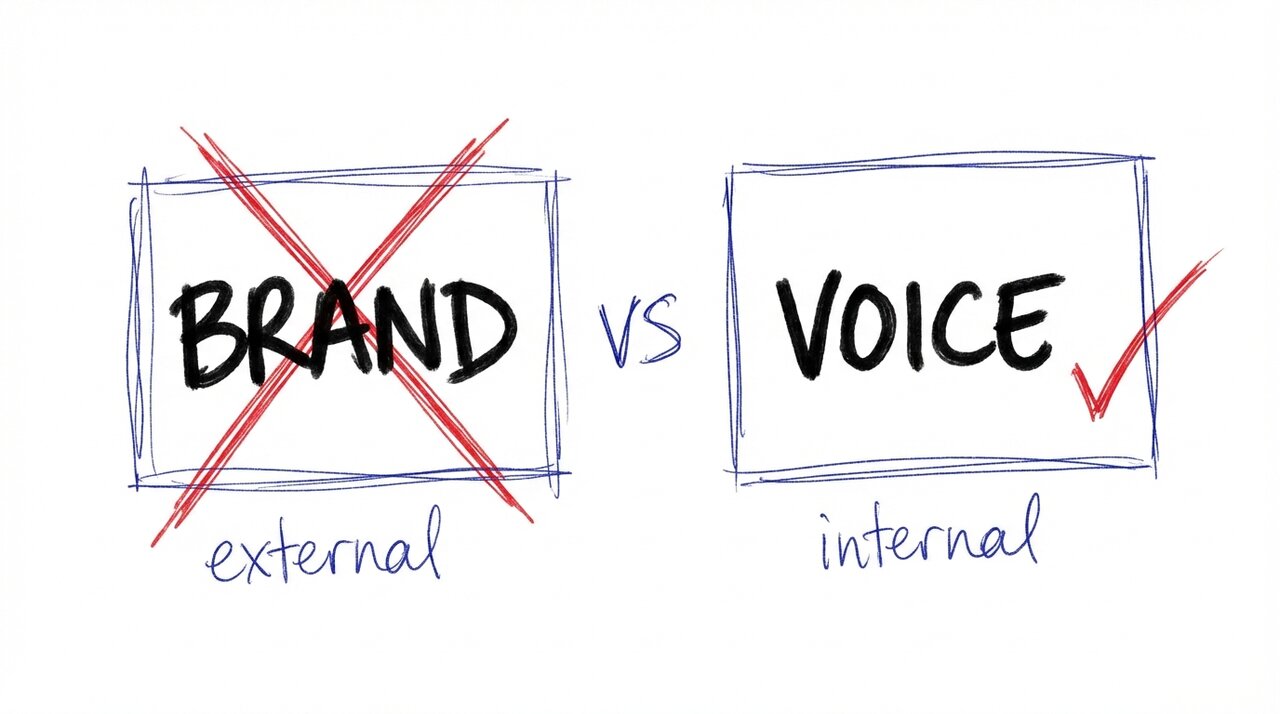
A brand is external. It’s strategic. It’s about how you want to be perceived, what you want to be known for, how you position yourself in some market, whether that’s a job market, a creator economy, or just the vague social hierarchy of the internet. A brand is something you construct and maintain.
A voice is internal. It’s emergent. It’s how you actually think and talk when you’re not trying to optimize for anything. It’s the way you explain things to friends, the tangents you go on, the things you find interesting even when nobody else seems to care. A voice is something you discover and let out.
You can have a strong personal brand with no authentic voice behind it. Plenty of people do. The feed looks great, the content is consistent, but there’s no there there.
And you can have a voice without any brand at all. You can write what you think, share what interests you, and let people make of it what they will.
What I Actually Want
I want to write when I’m inspired. When something’s stuck in my head and I need to work through it. When I learn something cool and want to share it with someone.
I want to tweet what’s on my mind without running it through a mental filter of “is this on-brand for me?”
No content calendar. No engagement strategy. No “building in public” with an ulterior motive. No pressure to be consistent or stay in a lane.
Some weeks I might write about software architecture. Other weeks about exploring half-formed ideas, or a random thought about cities, or nothing at all. That’s fine. That’s how actual people work.
Not a Manifesto
This isn’t some grand declaration about quitting the game or rejecting the internet or whatever. I’m not mad about it. I don’t think personal branding is evil. It’s useful for a lot of people in a lot of contexts.
I’m just shifting my mindset.
The best conversations I have are with friends where neither of us is performing. Where we’re just talking about what we’re thinking about. That’s the energy I want here.
So that’s the plan. Write when there’s something to say. Let the voice be the voice. See what happens.