In 2016, Hayao Miyazaki was shown an AI-generated animation. A grotesque humanoid figure dragged itself across the floor in a way no human had ever moved. The team presenting it suggested it might be useful for animating zombies.
Miyazaki sat for a moment. Then he told them the people who made it had “no idea what pain is.” He called it “an insult to life itself.”
The clip has aged into a near-meme. Underneath the reaction is the cleanest articulation I know of a Japanese word the West keeps fumbling.
Shokunin.
What Shokunin Actually Means
The literal translation of 職人 is “craftsperson.” That barely scratches it.
Shokunin describes someone whose skill, temperament, repetition, and social role have fused into a single thing over time. Not a perfectionist. Not a solitary genius suffering for art. Not even, especially, an artist. A shokunin is a worker whose craft has become an obligation to the people their work touches.
The woodworker Toshio Odate, the person who pretty much defined this word in English, said the shokunin has “a social obligation to do his or her best for the general welfare of the people.” Skill plus attitude plus duty. The miyadaiku, the carpenters who maintain Japan’s shrines and temples, fit that cleanly. So do the urushi lacquer specialists who finish work that began with someone else’s hands and will end in someone else’s again. Their craft sits inside a lineage and a community. It is not theirs alone.
The ones we always cite are real but partial. The fuller picture includes a lot of quiet, communal, unglamorous work done by people who would never call themselves masters. George Nakashima, the Japanese-American woodworker, used to say that a board of wood has only one ideal use, and the maker’s job is to find it. Jiro Ono has been shaping rice for over seventy-five years and still thinks his rice is not quite right (the subject of Jiro Dreams of Sushi). The potter Shoji Hamada built a life out of making cups and bowls for everyday use, and signed almost none of them. Different rooms, same disposition. They have all become answerable to the material in front of them.
Hold that in your head. The shokunin is not the romantic figure. The shokunin is the person who has become answerable to the thing they make.That answerability is the part AI is currently rearranging.
AI Lowered the Cost of Looking Like a Shokunin
You can now ship a polished website in an afternoon without knowing why one decision is better than another. You can release a song. You can publish a logo. You can write a novel in a weekend. You can author a paper, ship a product, or hand off a deck for half a dozen disciplines you have never practiced.
This is, mostly, good. I am not nostalgic for the days when the cost of an idea was a department.
But there is a specific thing happening underneath all that ease, and we should be honest about it.
AI did not just lower the cost of producing artifacts. It lowered the cost of appearing to have learned the craft that produces them. Those are different things, and the gap between them is where the trouble lives.
A vibe-coded app and a thoughtful one can look identical from the outside on day one. They diverge on day ninety, when the first hard decision arrives and one of them has nobody home to make it.
Drift
I want to give that gap a name. The word I keep landing on is drift .
Drift is producing more artifacts while becoming less changed by the act of making them.It is a quiet failure mode, because the outputs keep arriving. The ship rate looks healthy. The portfolio fills up. From the outside, the practitioner looks more productive than ever. The instrument itself, the person, has stopped sharpening.
In practice, drift comes from a few specific things AI does to the practice loop:
- It replaces construction with selection. You stop building things from first principles and start choosing among options the model offered.
- It hides shallowness behind fluency. The output looks finished, so you never see the structural problem you would have hit if you had built it yourself.
- It skips the frustrating middle. The struggle phase, which is where most durable intuition forms, gets compressed into a few prompt iterations.
- It rewards breadth over repetition. Iteration is so cheap that you hop to the next variation instead of sitting with one problem long enough to internalize it.
- It weakens the feedback loop. Deliberate practice depends on attempting, failing, diagnosing, correcting. AI usually hands you something acceptable before failure has had a chance to teach you anything.
None of these are the model’s fault. They are choices we make about how to use it.
The shokunin loop is built on the parts AI smooths over. Repetition. Diagnosis. Correction. Sitting with a problem long enough to see its shape. Outsource that loop entirely and you do not become a faster shokunin. You become something else.
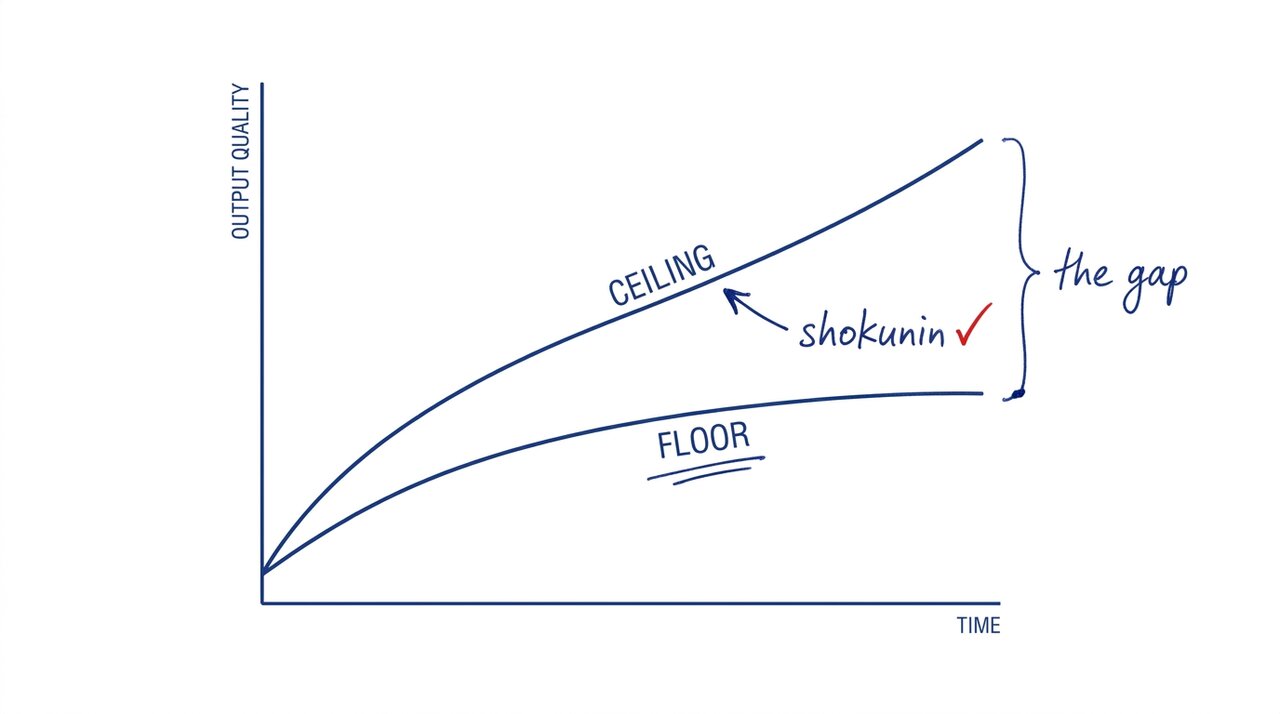
The Floor Rose. The Ceiling Rose Faster.
Here is the part most coverage gets wrong.
AI is not flattening the curve. It is stretching it.The floor rose, because anyone can now produce passable work in any medium. That is real and worth celebrating.
But the ceiling rose too, and it rose faster. A practitioner with deep judgment can explore more options, kill bad directions sooner, and ship at a quality bar they could not have reached alone. AI is an apprentice multiplier. It makes the master more leveraged and the amateur more convincing at exactly the same time.
The middle is what gets hollowed out. The decent generalist who used to make a living on competent execution is now competing with a model that does competent execution for almost nothing. Cheap competence increases the value of expensive judgment.
This is the structural reason the shokunin idea matters more, not less. When production is the bottleneck, you reward people who can produce. When evaluation is the bottleneck, you reward people who can tell.
I wrote a version of this in When Anyone Can Build, Judgment Wins. Same principle, different lens. There it was about product judgment. Here it is about craft judgment. Both are downstream of the same shift.
Taste, Defined Properly
People keep saying taste is the new moat. I find that phrasing slightly embarrassing, because it makes taste sound like a marketing asset. It is not.
Taste is trained judgment about what matters.It is the ability to perceive meaningful differences, rank them under real constraints, and choose the tradeoff that best serves the work. That is not the same as preference (what you happen to like) or aesthetic sense (what you can recognize as attractive). Preference says “I like this.” Taste says “this is the right choice for this material, this audience, this moment, and here is what it preserves.”
Two domains where this is currently visible.
Illustration and brand design. AI can generate endless attractive frames in seconds. The hard part was never one pretty image. It was building a visual system that survives fifty downstream decisions: how the typography behaves at small sizes, what the brand tolerates and refuses, what restraint looks like across a year of touchpoints. The illustrator who can hold that in their head is more valuable now, not less. Anyone with a prompt can make the first frame. Almost nobody can hold the whole language.
Music production. Generative models can sketch songs, render genre pastiche, and even mix passably. What they cannot do is hear when the chorus arrives eight seconds too early, when the low end is lying about what is actually there, or when the perfect take has had the life polished out of it. Producers who have sat with thousands of mixes notice these things. They are not magic. They are pattern compression earned the hard way, on real material, with real consequences.
In both cases the AI is not the threat. The threat is the practitioner who decides the AI is enough, and quietly stops developing the ear or the eye that would have made the AI useful in the first place.
The shokunin version of taste is not aristocratic. It is bound to function and consequence. It is the discipline to leave the extra trick out. It says less “what expresses me?” and more “what does the work require?”
You build that by doing the work. Not by watching the work. Not by curating the work. Doing it, badly, and then less badly, for a long time.
The Apprenticeship Inversion
There is one more thing happening that I have not seen named cleanly.
The old apprenticeship model forced you to internalize standards before you were given full power. You swept the floor for a year. You made the same cut a thousand times. You were not allowed to plate the dish. The point was that judgment had to arrive before capability, because capability without judgment is dangerous to other people.
AI flipped that order.
Now novices can produce polished output long before they have any judgment about it. The visible signs of competence arrive years earlier than the invisible structures that used to justify them. The work looks finished. The author has not been formed.
That is not a moral problem. It is a structural one. It means we have to be much more deliberate about how mastery actually gets built, because the environment will no longer build it for us by default.
How to Stay a Shokunin When the Tools Won’t Make You One
I do not think the answer is to refuse the tools. I use them constantly. The shokunin idea is not anti-technology. It never was.
The answer is to be deliberate about which parts of your craft you protect from outsourcing, and why.
A few principles I have been trying to live by, mostly badly.
Pick something. Go absurdly deep. The depth is the lens. I wrote about this in Weird Knowledge Compounds. You cannot have shokunin-level taste in everything. You can have it in one thing, and let that one thing color how you see the rest.
Decide where craft lives and where speed lives. AI slop belongs in the prototype, the throwaway, the place where learning beats polish. It does not belong in the load-bearing decisions, the trust-bearing surfaces, or the parts of the craft that earn the taste in the first place. More on that line in AI Slop Has a Place.
Keep one loop sacred. Choose at least one part of your practice you will do without the model. Not out of nostalgia. To keep the instrument tuned. The shokunin loop is what the loop is for.
Stay answerable. The thing that makes a shokunin a shokunin is not the rice. It is the seventy-five years of being responsible for the rice. AI can help you ship faster than ever. It cannot stand behind the work for you.
The bar is rising. The ceiling is rising faster. The people who become answerable to their craft, and stay answerable, are going to look very different from the people who learned to manage a model that does the work for them.
Both will ship things. Only one of them will be a shokunin.