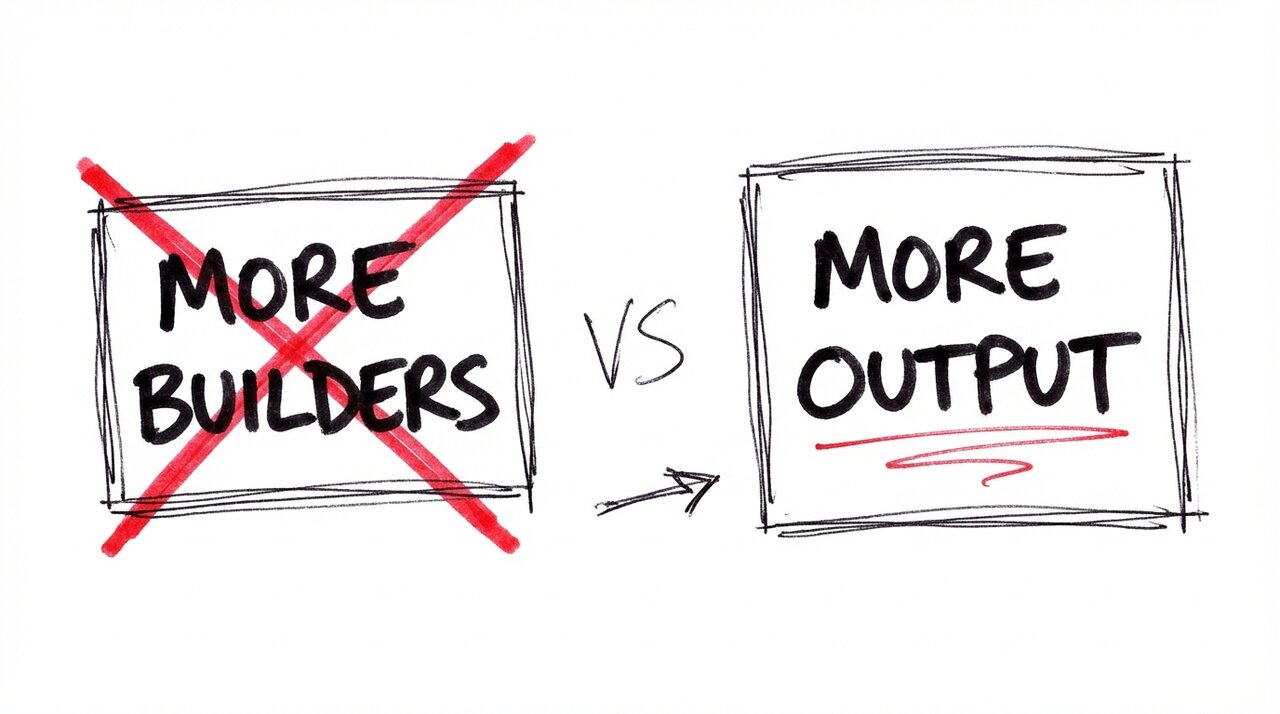
The pitch goes something like this: AI will make software creation instant and free. Natural language is the new programming. Soon, everyone will spin up their own personalized apps, agents, and workflows. The scarcity shifts from engineers to infrastructure. Own the platform, not the product.
It’s a compelling story. And parts of it are true.
The first time I watched an AI scaffold a full React app in thirty seconds, my lizard brain absolutely believed this was the end of frontend engineers. The friction of syntax, boilerplate, and yak-shaving has genuinely collapsed. For certain kinds of work, months compress into hours.
But here’s the thing the pitch leaves out: people don’t wake up wanting to build software. They want solved problems. Working businesses. Delightful experiences. Given the choice, most people would rather pay to have something done for them than do it themselves.
That preference doesn’t change just because the tools got better.
We’ve Seen This Movie
Every technology wave brings the same prophecy: the tools are so powerful now that the creators are basically optional.
No-code was supposed to end developers. Bubble, Zapier, Airtable, Webflow. “Anyone can build apps now.” And yes, these tools are great for prototypes, internal dashboards, and simple workflows. But the moment you hit complexity, edge cases, or integration with legacy systems, you want an actual engineer. Many “citizen dev” platforms ended up primarily used by developers and power users.
Removing syntax doesn’t remove complexity. It just moves where complexity lives.
Cameras were supposed to end photographers. Every smartphone has portrait mode. Everyone can shoot in 4K. Yet professional photographers didn’t vanish. They moved up the value chain: brand shoots, storytelling, commercial work. The gap became about taste, point of view, and curation, not shutter speed.
Everyone has a camera. Very few can direct a subject, pick a location, and tell a story in ten images.
Desktop publishing was supposed to end designers. PageMaker and laser printers gave us a golden age of horrific newsletters, clip-art brochures, and WordArt flyers. Over time, actual designers became more essential for anything important or public-facing.
Lowering the bar for entry increases volume far more than it increases quality.
The pattern is consistent: participation grows modestly at the margins, expectations at the top rise, and people still pay for done-for-you.
The Real Bottleneck Isn’t Syntax
“Natural language is the new programming.”
It’s a phrase Andrej Karpathy popularized in early 2023: “The hottest new programming language is English.”
Sounds like magic. Tell the computer what you want.
The problem: most people don’t actually know what they want in enough detail.
A programmer’s core skill isn’t typing for loops. It’s turning mushy business desires into precise behavior. Specs emerge through questions, prototypes, and trade-offs, not a single perfect prompt.
“Make my life easier” isn’t a specification.
“When this email arrives, update this spreadsheet and notify that Slack channel” is, and that’s already today’s power-user zone.
We removed the need to memorize syntax. We didn’t remove the need to think clearly.
Then there’s the maintenance tax. Building v1 is about 20% of the cost. The next five years of changes, debugging, and evolution is the other 80%. Every “quick tweak” request has knock-on effects: data migrations, permissions, performance, integrations. An AI that spits out a first version doesn’t magically handle ongoing maintenance.
You ask an AI to build a simple internal CRM. You get a pile of code that works for a demo. Two months later, nobody knows how it works, it doesn’t handle your actual weird sales process, and a developer concludes it’s cheaper to rebuild from scratch.
Who Actually Benefits
If the “everyone becomes a developer” story is overblown, who actually wins?
Existing developers. This is an enormous productivity boost. Less time on boilerplate, migrations, and glue code. More time on architecture, product decisions, and the gnarly bugs that actually matter. The job shifts from “human compiler” to editor, architect, and product partner.
I used to spend weeks on features that now take hours. That’s not hype. That’s my actual experience.
Power users. Analysts, ops folks, marketers, tech-savvy PMs. People who already bend Excel, Zapier, and Notion to their will. They can now automate more workflows without waiting on engineering. Query data, transform CSVs, build small internal tools.
This is the real expansion of “who can develop,” from maybe 1% to 5-10%. That’s meaningful. It’s not everyone.
Small teams. A three-person startup can now ship what used to require eight engineers. Non-technical founders can get from idea to working prototype without a full dev team. It doesn’t remove the need for engineering. It delays when you need it and reduces how many you need.
The constraint shifts from “can we build it?” to “can we find something worth building and keep it alive?”
The Market That Actually Exists
VCs aren’t stupid. They’re optimizing for a certain kind of bet. The mistake is assuming “infinite software” means “no need for experts or products.”
Here’s what the landscape looks like:
- A thick layer of AI-powered tooling: smarter IDEs, API builders, workflow engines, data wranglers
- A huge long tail of semi-bespoke automations and micro-apps, built by power users and small teams
- And persistent demand for polished products: well-run businesses, beloved software, trustworthy infrastructure, specific outcomes delivered reliably
The winners will build tools with a clear vision of the outcomes they enable. They’ll solve narrow, painful problems end-to-end instead of shipping generic APIs and hoping magic happens.
If you’re a developer: lean into the parts of the job that are hardest to automate. Domain understanding, taste, systems thinking, collaboration. These are the skills that create genuine edge. The job is changing. The job isn’t disappearing.
If you’re building tools: obsess over the outcomes your users want. Not the capabilities of your platform.
Better tools make builders more productive. They don’t turn everyone into builders.
The market for “do it yourself” is smaller than the market for “do it for me.” It always has been.